

AI-Based Security Operations Center (SOC): Smarter, Faster, Stronger
Cyber compliance is no longer an annual checklist or audit. Ransomware, insider threats, supply chain attacks, and cloud misconfigurations change every day, making compliance and risk assessment constant, adaptive, and intelligence-driven. The rise of AI-based Security Operations Center (SOC) as the foundation of modern cybersecurity has increased.
AI is integrated into CyberShield CSC’s threat detection, risk assessment, and compliance management across complex IT environments. AI-powered SOC services, Security Operations Center automation, and a dedicated Compliance Strategy with a Virtual CISO provide real-time visibility, predictive risk insights, and measurable security posture improvements.
What Is an AI-Based Security Operations Center (SOC)?
Next-generation AI-based Security Operations Center (SOC) leverages machine learning and advanced analytics to continually monitor, detect, investigate, and respond to cyber attacks. AI-powered SOCs learn from data, recognize patterns, and react to new attack techniques in real time, while traditional SOCs use predetermined rules and manual analysis.
SOCs automatically correlate massive endpoint, network, cloud workload, identity, and app metrics to identify risks and reduce noise. In SOC 2, ISO 27001, HIPAA, PCI DSS, and SOX, an AI-based SOC is a living compliance engine.
Limitations of Manual and Rule-Based SOCs
1) Over-Reliance on Static Rules and Signatures
Traditional SOCs rely on established rules, signatures, and compromise indications. Although effective against known threats, static rules cannot detect new attack methods, zero-day exploits, or fileless malware.
2) High False Positive Rates and Alert Overload
Rule-based systems generate excessive alerts because they lack contextual awareness. Alerts from minor anomalies, administrative activities, or legitimate user behavior overwhelm SOC analysts. Alert overload causes analyst fatigue, delayed investigations, and operational risk by missing key risks.
3) Limited Ability to Detect Advanced and Stealthy Attacks
APTs, insider threats, and lateral movement are difficult to detect in manual SOC operations. These attacks rarely activate standard rules because they mimic system behavior.
4) Slow Incident Detection and Response Times
Manual triage, investigation, and response make MTTD and MTTR go up by a lot. Analysts have to look at alerts by hand, get context, and decide on a fix, which slows down containment and makes the harm from the breach worse.
5) Inadequate Predictive and Proactive Skills
Rule-based SOCs react. They only react when a pattern matches; they cannot predict new dangers or risk trends. Proactive cybersecurity and compliance risk prediction is difficult with this reactive approach.
How AI Transforms SOC Operations from Reactive to Predictive
AI fundamentally changes SOC operations by shifting security teams from reacting to alerts to predicting threats before damage occurs. Machine learning models analyze historical attack patterns, user behavior, and environmental baselines to forecast potential risks.
This predictive capability enables SOCs to prioritize vulnerabilities, flag suspicious behavior early, and initiate preventive controls automatically.
For CyberShield CSC clients, this means fewer breaches, faster compliance remediation, and stronger alignment with a proactive cybersecurity strategy.
Core Components of an AI-Powered SOC
A next-generation SOC has a lot of AI-powered parts that all work together. Some of these are intelligent data intake pipelines, powerful analytics engines, automated response orchestration, and centralized visibility dashboards. When put together, they provide a security ecosystem that can handle large-scale modern attack surfaces.
1) Centralized Data Ingestion & Telemetry Collection
An AI-powered SOC continuously ingests massive volumes of security data from endpoints, firewalls, network devices, cloud platforms, identity providers, SaaS applications, and third-party integrations. Unlike traditional SOCs that struggle with data overload, AI normalizes, enriches, and correlates this telemetry in real time.
2) AI-Enhanced SIEM (Security Information and Event Management)
At the core of a next-generation SOC is an AI-enhanced SIEM platform that goes far beyond log aggregation. AI-driven SIEM analyzes patterns, establishes behavioral baselines, and dynamically detects anomalies instead of relying solely on static correlation rules. This allows the SOC to uncover sophisticated attacks, insider threats, and misconfigurations that traditional SIEM systems often miss, while also supporting audit-ready logging and compliance reporting.
3) Machine Learning–Driven Threat Detection Engine
Machine learning models learn from past events, global threat intelligence, and environmental behavior. As attacker strategies change, these models detect zero-day, fileless, and advanced persistent threats. This capability turns the SOC into a predictive defense system with a proactive cybersecurity strategy.
4) Behavioral Analytics & User Entity Behavior Analytics (UEBA)
AI-powered SOCs use behavioral analytics to monitor how users, devices, applications, and service accounts behave over time. Any deviation, such as unusual login times, abnormal data access patterns, or unexpected privilege escalation, is flagged instantly. This component is critical for enforcing Zero Trust principles, identifying insider threats, and supporting compliance frameworks that emphasize access control and continuous monitoring.
5) Automated incident prioritization
AI-powered triage systems evaluate warning severity, business impact, and compliance risk. SOC warns only high-confidence, high-risk scenarios, not thousands of low-value reports. Intelligent prioritisation reduces alert fatigue and helps security teams focus on breaches and regulatory violations.
Identity and Access Monitoring in SOC Operations using AI
AI monitors real-time behavior for credential misuse, privilege abuse, and improbable travel conditions.
Access controls, audit trails, and user responsibility compliance frameworks must always know who people are.
AI-Based SOC for Cloud, Hybrid, and Remote Settings
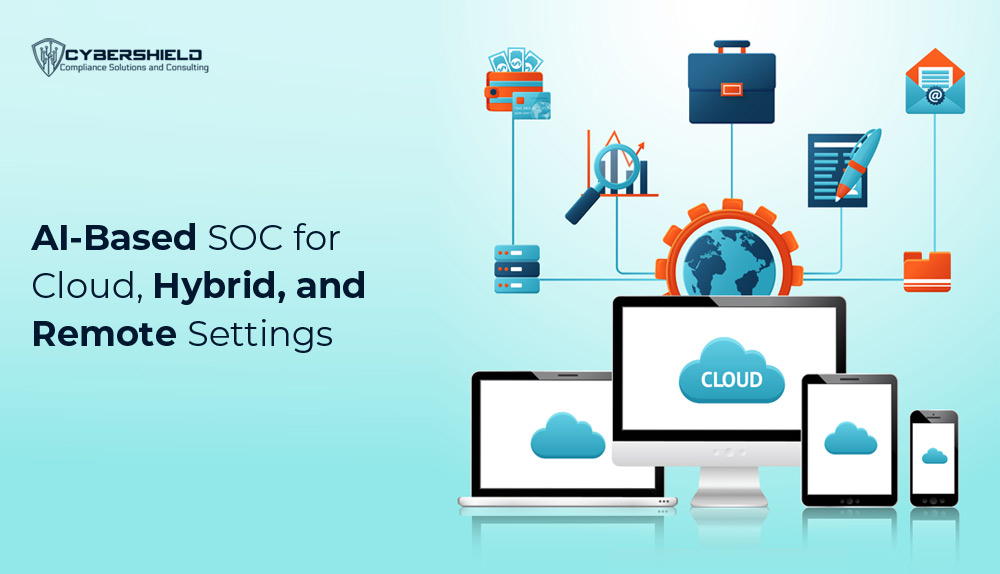
As infrastructure becomes less centralized, AI-based SOCs are the best method to keep cloud-native and remote-first environments safe.
CyberShield CSC’s AI-based SOC services keep people and data safe no matter where they are.
Key Risks of Operating Without an AI-Enabled SOC
Without AI, organizations face delayed detection, higher breach impact, audit failures, and regulatory penalties. In a landscape where AI is changing cyber compliance, operating without AI-enabled defenses is a measurable business risk.
1) Delayed Threat Detection and Extended Dwell Time
Without AI-driven threat identification and response, many attacks go undetected for days or months. Manual and rule-based SOCs typically miss small signs of compromise, allowing attackers to stay longer, move laterally, elevate privileges, and exfiltrate sensitive data.
2) Inability to Detect Zero-Day and Advanced Persistent Threats (APTs)
Classic SOCs use known signatures and predefined criteria, which fail against zero-day vulnerabilities and sophisticated APTs. Without machine learning and behavioral analytics, enterprises are ignorant to new attack methods that bypass old security systems.
3) Severe Alert Fatigue and Analyst Burnout
Non-AI SOCs have high false positives and little contextual intelligence. Analysts must sort through thousands of low-value warnings daily, raising the risk of overlooking real threats. Alert weariness slows response times, complicates investigations, and increases personnel attrition.
4) Slow Incident Response and Increased Breach Impact
Incident triage and response are manual without Security Operations Center automation. Due to increased Mean Time to Respond (MTTR), attacks can spread and cause more operational, financial, and reputational damage.
The future of cybersecurity lies in predictive intelligence, automation, and strategic oversight. Businesses must invest in next-generation SOC solutions that align security with risk and compliance.
CyberShield CSC helps firms develop resilient SOC strategies that adapt to threats, laws, and technology.