
AI-Powered Cyber Compliance Monitoring: Stay Audit-Ready Always
In today’s regulatory environment, compliance is a year-round requirement. Due to changing data privacy legislation, industry-specific mandates, and escalating cyber risks, organizations must demonstrate their security measures at all times, not just during audit season.
Here, AI-powered cyber compliance monitoring changes everything. Organizations can stay audit-ready every day with real-time visibility, automated reporting, and predictive risk insights instead of scurrying to gather proof.
At CyberShield CSC, we see firsthand how AI is changing cyber compliance. Through advanced automation, continuous control validation, and strategic oversight via vCISO services, organizations can shift from reactive compliance to proactive governance, risk, and compliance management.
What Is AI-Powered Cyber Compliance Monitoring?
AI-powered cyber compliance monitoring tracks, assesses, and validates IT compliance controls using artificial intelligence, machine learning, and automation.
AI-based compliance monitoring assesses systems, users, networks, cloud environments, and apps, unlike spreadsheets, manual checks, and static documentation.
In essence, AI-powered compliance tools act as a digital compliance analyst operating 24×7.
Challenges of Manual and Periodic Compliance Audits
1. Compliance Becomes a “Project” Instead of a Process
Compliance done manually is generally a short-term undertaking with audit deadlines. Teams race to document, validate controls, and prepare reports weeks before auditors arrive.
Audit gaps result from this reactive cycle. If controls slip out of alignment months after the last assessment, they go undetected without regular monitoring. Compliance becomes an annual rush instead of a daily routine.
2. Limited Visibility Across Modern IT Environments
Manual compliance techniques cannot provide complete visibility across scattered ecosystems. Static checklists and spreadsheets cannot track real-time configuration changes, access updates, or cloud misconfigurations.
Security personnel have little visibility, increasing the chance of rules infractions.
3. Human Error and Inconsistent Reporting
Manual data collection introduces unavoidable risks, such as misinterpreted control requirements, incomplete documentation, outdated screenshots, and inconsistent formatting across reports.
Even experienced compliance teams can make mistakes when managing large volumes of evidence manually. Small errors, such as failing to document a quarterly access review, can lead to audit findings or non-compliance notices.
Over time, inconsistent reporting weakens organizational credibility during regulatory assessments.
4. Time-Consuming Evidence Collection
A major pain point for compliance auditors is gathering evidence.
In manual environments, teams are tasked with obtaining data from various departments, validating timestamps, organizing files, and cross-checking requirements. Because of how long this can take, security resources are taken away from preventing threats in the first place.
There is a tremendous loss of opportunity. Teams should be focusing on defense rather than paperwork.
5. Monitoring Changes Between Audit Periods
Periodic audits provide a clear picture. Inadequate oversight could covertly erode the effectiveness of control. If a firewall rule is updated six months after an audit, it might not be reported or exploited until the next audit.
Periodic compliance procedures have control drift as a serious defect.
How AI Enables Continuous Compliance Instead of One-Time Checks
Continuous compliance security solutions powered by AI monitor and control performance in real time.
Rather than waiting for quarterly reviews, AI systems:
- Track configuration changes instantly
- Monitor access controls dynamically
- Detect policy deviations as they happen
- Validate encryption and data protection measures continuously
This transition from static audits to dynamic monitoring ensures that compliance becomes an embedded operational process rather than an annual event.
Key Regulations and Frameworks AI Helps Monitor
AI-driven compliance tools are designed to align with major regulatory frameworks, including:
- International Organization for Standardization (ISO 27001) – Information security management systems
- American Institute of Certified Public Accountants (SOC 2) – Trust Services Criteria
- Health Insurance Portability and Accountability Act (HIPAA) – Healthcare data protection
- General Data Protection Regulation (GDPR) – Data privacy regulations in the EU
- Payment Card Industry Data Security Standard (PCI DSS) – Payment card data protection
AI systems map security controls directly to regulatory requirements, ensuring continuous alignment across multiple frameworks simultaneously.
Core Components of an AI-Driven Compliance Monitoring System
A good AI-powered cyber compliance monitoring system is a network of smart technologies, automation engines, and governance frameworks. Organizations need layered architecture with real-time visibility, predictive insights, and audit-ready documentation to offer continuous compliance security solutions.
1. Automated Control Mapping Engine
Any compliance program starts with control mapping. ISO 27001, SOC 2, HIPAA, GDPR, and PCI DSS all require technical and administrative controls.
AI aligns spreadsheets across frameworks without operator intervention. Organizations using several standards will benefit from this.
2. Continuous Data Ingestion and Monitoring Layer
AI-based compliance monitoring requires constant data ingestion from throughout the IT environment.
Configuration states, access logs, policy updates, vulnerability data, and system changes are collected live by the AI engine. So compliance monitoring represents the current environment, not outdated snapshots.
3. Machine Learning Risk Analysis Engine
Raw data is insufficient. Machine learning-powered intelligence examines patterns and behaviors to assess risk.
Machine learning evolves, unlike rule-based monitoring. It improves compliance alert accuracy and decreases false positives.
Modern cybersecurity compliance management relies on speed and accuracy.
4. Real-Time Policy Enforcement and Alerting System
When AI finds something that doesn’t follow the rules, it’s important to act right away.
For instance, if multi-factor authentication is turned off for a privileged account, the system can immediately tell administrators or even start automated enforcement.
This cuts down on exposure time and helps with continual control validation.
5. AI-Based Evidence Collection and Audit Trail Automation
Audit preparation generally requires a lot of internal resources. Evidence collecting is automated by AI, eliminating this bottleneck.
Centrally stored evidence is grouped by framework and control. Instant reports are issued for auditors who request documentation.
This functionality underpins AI-driven audit readiness solutions.
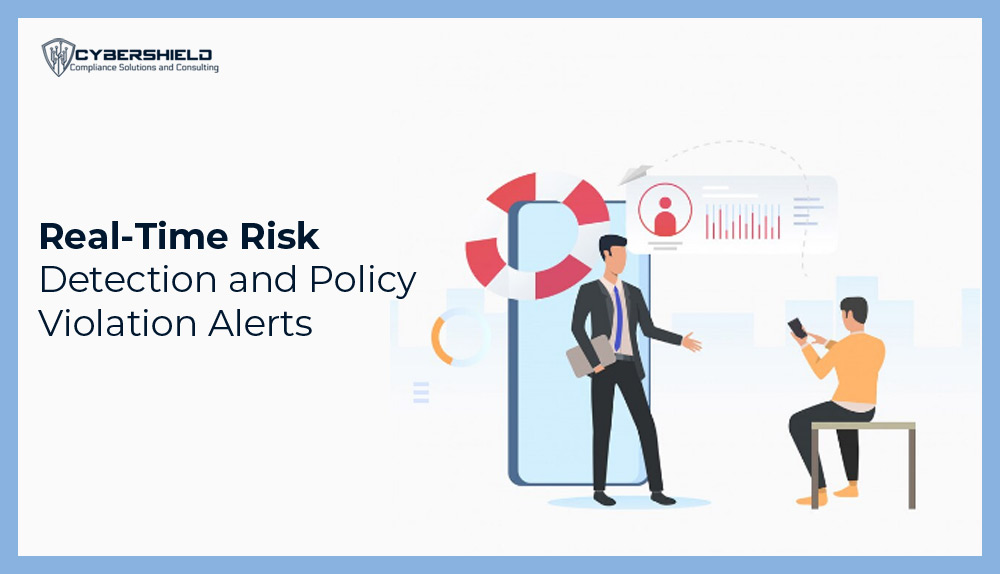
Real-Time Risk Detection and Policy Violation Alerts
One of the most transformative advantages of AI-powered cyber compliance monitoring is its ability to detect risks and policy violations the moment they occur. In a modern IT environment where configurations change rapidly, and users access systems from multiple locations, delayed detection can mean the difference between minor remediation and major regulatory exposure.
Real-time monitoring ensures that compliance is not just documented, it is actively enforced.
Traditional compliance tools often rely on periodic scans or scheduled reviews. In contrast, AI-powered systems operate continuously, ingesting live data from:
- Identity and access management platforms
- Cloud infrastructure environments
- Endpoint protection tools
- Firewalls and network devices
- SaaS applications
- Databases and storage systems
This persistent monitoring layer allows AI engines to evaluate compliance posture at every moment, not just during audits or review cycles.
This permanent monitoring layer lets AI engines assess compliance at any time, not just during audits or reviews.
AI Compliance Monitoring with SOC/SIEM
AI compliance monitoring works best with SOC and SIEM integration.
When compliance monitoring and incident detection systems match, security teams get unified visibility. Compliance system alerts can initiate SOC investigations for fast remediation and cross-functional collaboration.
This integration makes compliance part of the security ecosystem at CyberShield CSC.
AI changes cyber compliance, but smart adoption makes automation measurable.
Also Read: AI-Based Security Operations Center (SOC): Smarter, Faster, Stronger