
How AI Is Changing Cyber Compliance Monitoring
Cyber compliance is no longer something you do once a year. As rules and regulations change and cyber threats change all the time, companies are always under pressure to show that their security measures are not only written down, but also operating. This is where AI is changing the way things are done in cyber compliance.
AI-powered compliance monitoring is transforming risk management from reactive to proactive. It is allowing organizations to move away from static, reactive compliance models toward dynamic, continuous oversight that aligns with real-world risk. AI-powered compliance monitoring is reshaping how organizations manage risk by enabling proactive oversight, real-time alerts, and continuous auditing.
At CyberShield CSC, compliance is treated as a living security function, not a regulatory burden. By combining AI-driven compliance monitoring with strategic leadership through a dedicated Virtual CISO, organizations gain visibility, accountability, and control over their compliance posture, without slowing down business operations.
Understanding Cyber Compliance Monitoring
Cyber compliance monitoring refers to the continuous process of ensuring that an organization’s security controls, policies, and practices align with regulatory standards such as ISO 27001, SOC 2, HIPAA, PCI DSS, NIST, and more. For years, compliance has been viewed as a necessary cost of doing business rather than a source of competitive advantage.
Traditionally, compliance focused on periodic audits and documentation reviews. That model is struggling to hold up for the modern enterprise – with regulations changing seemingly overnight and data flowing across dozens of platforms.
Today, regulators and stakeholders expect proof of ongoing adherence, not historical snapshots. New regulations are being drafted for businesses that use AI, and existing regulations are becoming more intricate and stringent in their implementation. Following the rules here is about more than just staying out of trouble; it’s also about building trust and building resilience.
Modern cyber compliance monitoring involves tracking system configurations, access controls, data handling practices, user behavior, and incident response readiness across complex IT environments that include cloud platforms, remote workforces, and third-party vendors.
Why AI Is a Game-Changer for Cyber Compliance
When it comes to measuring and managing compliance, AI is a game-changer. When it comes to cybersecurity compliance, AI is replacing manual reviews and static rules with continuous analysis of system activity, policy adherence, and risk patterns.
Artificial intelligence in cybersecurity compliance can identify anomalies, correlate security events with compliance controls, and flag deviations before they escalate into violations. This shift transforms compliance from a reactive obligation into a proactive security advantage, something CyberShield CSC emphasizes when building compliance strategies with a Virtual CISO.
AI-powered monitoring tools now enable continuous oversight, scanning transactions, communications, and system logs in real time to detect anomalies and policy breaches before they escalate.
AI-driven compliance monitoring combines machine learning, algorithms, natural language processing, prediction models, and automation. These systems ingest both structured data, such as logs and spreadsheets, and unstructured data from documents like policies, emails, and PDFs.
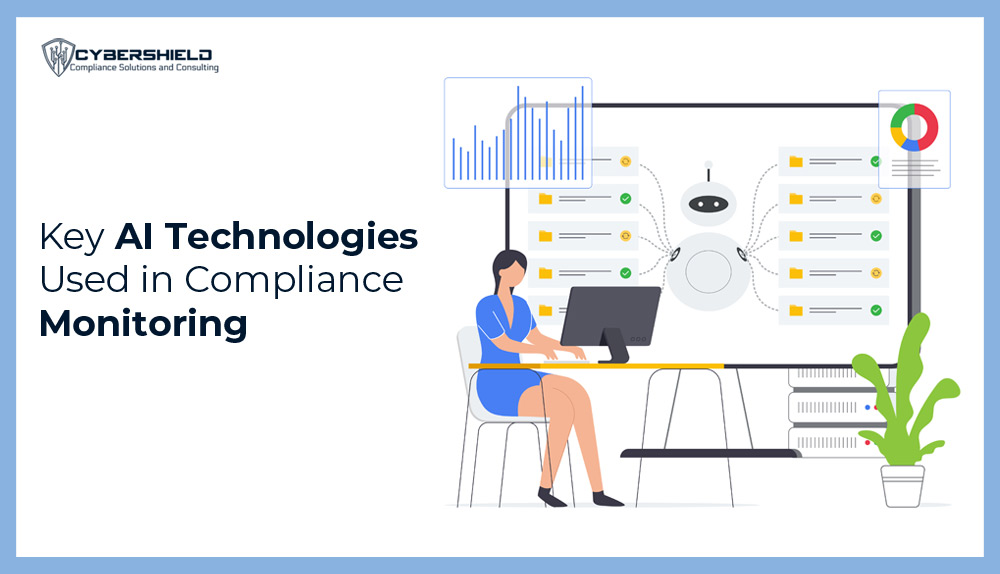
Key AI Technologies Used in Compliance Monitoring
1) Machine Learning (ML) for Compliance Pattern Analysis
Machine learning models look at a lot of past and present security data to set compliance baselines. These technologies figure out what “normal” compliance behavior looks like by looking at networks, cloud environments, and user activity. ML quickly detects changes that potentially lead to regulatory problems, as when configurations drift, controls fail, or access patterns change. This is much faster than a manual audit would catch them.
2) Behavioral Analytics for User and Access Compliance
Behavioral analytics monitor system, data, and application use. Text-heavy regulatory systems are difficult to understand. AI systems can read, understand, and sort NIST, HIPAA, SOC 2, and ISO 27001 compliance requirements using NLP. This automatically links regulatory language to technological limits, reducing misconceptions and helping businesses comply with changing laws.
3) AI-Powered Configuration Monitoring
AI continuously scans system and cloud configurations to ensure they remain compliant with security policies and regulatory requirements. It detects misconfigurations such as unsecured storage, weak encryption settings, or exposed APIs, issues that often lead to both compliance failures and data breaches.
Automating Compliance Audits with AI
AI makes audits a lot easier. AI systems provide audit-ready reports automatically by constantly checking controls, so you don’t have to collect evidence by hand. Real-time organization and mapping of logs, access records, configuration states, and event histories to regulatory requirements.
This level of automated compliance monitoring not only accelerates audits but also improves accuracy, eliminating human error and last-minute scrambles.
Continuous Compliance Monitoring Using AI
Compliance is no longer periodic; it is continuous. AI enables organizations to maintain a constant state of readiness by validating controls around the clock. Any deviation from compliance baselines is flagged immediately, allowing teams to remediate before violations occur.
CyberShield CSC integrates continuous compliance monitoring into its managed security and governance services, ensuring clients remain compliant even as their environments change.
Benefits of AI-Driven Cyber Compliance Monitoring
1) Continuous Compliance Visibility
AI lets you check security controls, configurations, and policies all the time, not just during audits, to make sure they are always up to date.
2) Early Detection of Compliance Gaps
AI finds problems like misconfigurations, access violations, and control failures as they happen, so businesses can fix them before they become audit findings or penalties.
3) Reduced Audit Stress and Preparation Time
Automated evidence collection and real-time reporting do away with the need to collect data by hand, which makes audits faster, easier, and more predictable.
4) Improved Accuracy and Consistency
AI reduces human mistake by doing the same compliance checks in all situations, which cuts down on the differences that often happen when people do reviews.
5) Real-Time Risk Prioritization
AI correlates compliance controls with active threat data, helping organizations focus on high-risk gaps that could lead to regulatory or security incidents.
6) Scalability Across Complex IT Environments
AI-driven compliance monitoring works well with cloud, hybrid, and remote infrastructures without adding to the workload of operations.
The main point is that AI may help compliance professionals in many essential ways. AI turns compliance from a cost center into a differentiator by automating dull tasks, uncovering important information, and spotting risks. Consulting, IT solutions, and cybersecurity companies don’t have to think about whether or not to employ AI in compliance; they only need to find out how quickly they can make it a part of their business model.
CyberShield CSC has a larger security plan that includes AI-driven compliance monitoring. This is led by dedicated officers who make sure that compliance helps the business expand instead of holding it back.