

Beyond Antivirus: Building a Proactive Cybersecurity Strategy That Lasts
For years, antivirus software was considered the cornerstone of cybersecurity. Install it, keep it updated, and you are “protected.” That assumption no longer holds true.
Today’s cyber threats are stealthier, faster, and far more sophisticated than traditional malware. Ransomware gangs operate like businesses. You can’t tell the difference between phishing emails and real ones. Zero-day exploits can get over defenses that are based on signatures.
Traditional defenses are no longer enough to protect against threats. If your cybersecurity starts and ends with antivirus, you’re not safe; you’re open to attack. The Managed Security Services (MSS) industry is growing quickly, with a forecast value of over $50 billion by 2025 and a compound annual growth rate (CAGR) of over 15%. This shows that more and more people are choosing to outsource their security.
At CyberShield CSC, we help organizations move beyond basic defenses and build proactive cybersecurity strategies designed to detect, prevent, and respond to threats before damage is done, while staying aligned with compliance standards and long-term business goals.
Why Traditional Antivirus Alone Is No Longer Enough
Traditional antivirus tools are designed to be reactive. They depend on known signatures, patterns that match previously identified malware.
That reactive mindset is like locking the front door while the back windows stay wide open. Threats today don’t wait politely at the doorstep. They slip through misconfigurations, target forgotten assets, and exploit assumptions.
Modern attackers rarely reuse the same code twice. Today’s attacks involve:
- Fileless malware that lives in memory
- Living-off-the-land attacks using legitimate system tools
- Social engineering and credential theft
- Supply chain compromises
- Zero-day vulnerabilities with no known signature
Antivirus may still stop basic threats, but it cannot provide advanced threat detection or visibility into attacker behavior. Businesses that rely solely on antivirus software often discover breaches weeks or months after the damage has already occurred.
Core Components of a Modern Proactive Cybersecurity Strategy
A proactive cybersecurity strategy is not a single tool or platform, it is a living security ecosystem that evolves with your business, threat landscape, and compliance obligations. Organizations that succeed don’t just “add security”; they operationalize it across infrastructure, people, and governance.
1) Risk-Centric Security Architecture
Proactive cybersecurity starts with understanding what truly matters to the business. Instead of deploying random tools, organizations must first identify critical systems and sensitive data, regulatory and compliance requirements, likely threat actors targeting their industry, and business processes that cannot afford downtime
CyberShield CSC designs security architectures based on real-world risk exposure, ensuring defenses are aligned with operational priorities, not vendor hype.
2) Advanced Threat Detection and Behavioral Analytics
Modern attacks don’t look malicious at first glance. That’s why proactive techniques use behavior-based detection instead of signatures. This comprises endpoint detection and response (EDR), network traffic analysis, cloud workload monitoring, and log correlation using SIEM or XDR platforms.
These tools detect abnormal behavior patterns, such as credential misuse, lateral movement, or privilege escalation, allowing threats to be stopped before they escalate into full-scale data breaches.
3) Continuous Monitoring and Security Operations
Cybersecurity isn’t a job that starts and ends at 9 a.m. Threats can happen at any time, and how quickly you respond affects how much harm they do. A proactive approach includes monitoring security around the clock and giving you a clear view of all your endpoints, networks, and the cloud.
CyberShield CSC provides continuous monitoring with a dedicated security officer, ensuring security events are analyzed, validated, and acted upon, not ignored or delayed.
4) Zero Trust Security Framework
Traditional perimeter-based security assumes that anything inside the network is trusted. That assumption no longer holds.
Zero Trust enforces continuous identity verification, least-privilege access, and device health validation.
This approach significantly limits an attacker’s ability to move laterally, even if credentials are compromised, making Zero Trust a core pillar of modern cyber defense solutions.
5) Identity and Access Management (IAM)
Identity has become the new attack surface. Stolen or misused credentials are now one of the most common causes of breaches.
Multi-factor authentication (MFA), role-based access control (RBAC), and privileged access management (PAM) are all parts of a proactive IAM strategy.
6) Threat Intelligence Integration
Threat intelligence provides context that raw security alerts cannot. By integrating intelligence feeds, organizations gain insight into active attack campaigns, emerging vulnerabilities, and industry-specific threats.
CyberShield CSC uses threat intelligence to rank risks, making sure that security teams focus on dangers that are most likely to hurt the business, not ones that are just ideas.
7) Security Awareness and Human Risk Management
People are often targeted before technology. A proactive cybersecurity strategy treats employees as defenders, not liabilities, through ongoing security awareness training, phishing simulations, and role-specific education.
Organizations with strong training programs experience fewer successful phishing attacks and faster incident reporting, dramatically reducing overall risk.
8) Continuous Compliance and Governance Alignment
Security and compliance are inseparable. A proactive strategy ensures continuous alignment with CIS Controls, i ndustry-specific compliance standards, i nternal governance policies, and audit readiness requirements.
Through Cyber Compliance Solutions and Compliance Strategy with a Virtual CISO, CyberShield CSC helps organizations maintain security maturity while meeting regulatory expectations.
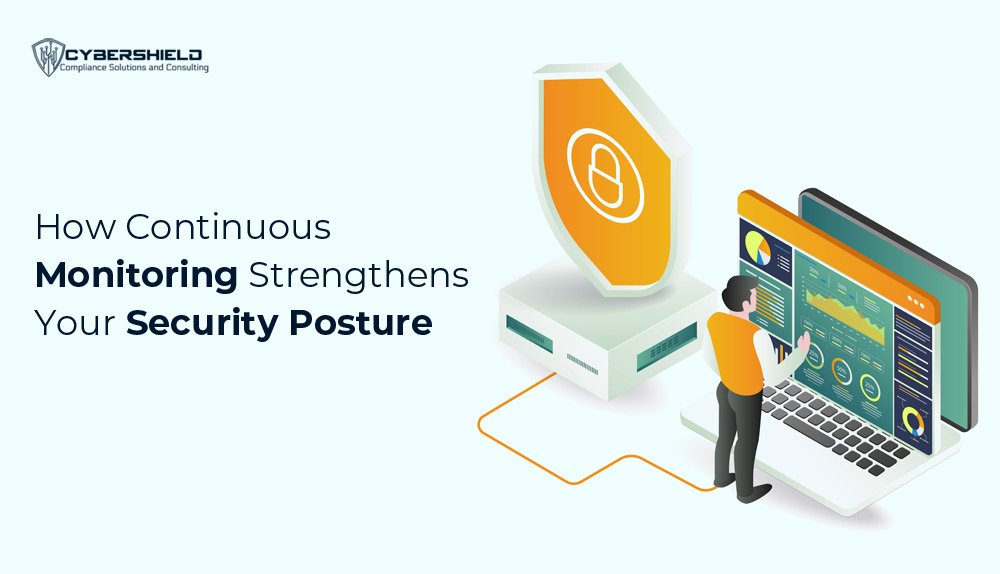
How Continuous Monitoring Strengthens Your Security Posture
Cyber threats don’t operate on a schedule, and your defenses shouldn’t either.
Continuous monitoring provides:
- Real-time visibility into networks, endpoints, and cloud environments
- Early detection of abnormal behavior
- Faster containment of suspicious activity
- Actionable alerts instead of noisy logs
By monitoring systems 24/7, CyberShield CSC helps organizations identify threats before they turn into data breaches, reducing dwell time and limiting operational impact.
How threat intelligence can help stop advanced attacks
Threat intelligence is a key part of helping businesses go from reactive defense to real proactive cybersecurity. Threat intelligence gives you the information you need to predict, spot, and stop bad behavior before it happens, rather than waiting for systems to be penetrated and then responding to attacks.
It turns raw security data into useful information by figuring out who is attacking your business, what kinds of attacks are happening right now, and what weaknesses are being leveraged in the wild.
Threat information helps security teams change their defenses to better deal with these new types of attacks. If organizations keep an eye on new threats and how their enemies act, they may improve their security measures, fix high-risk flaws more rapidly, and base their detection criteria on real-world attack scenarios instead of guesses.
When threat intelligence is used in security operations, it makes decisions and responses much faster.
At CyberShield CSC, threat intelligence is built into ongoing monitoring and incident response processes. This makes sure that security measures are fast, focused, and based on facts.
How to Create a Long-Term, Scalable Cybersecurity Roadmap
A lasting cybersecurity strategy aligns with business growth. It recognizes that security isn’t something you add on. It’s something you build in. Every asset mapped. Every risk understood. Every control aligned to purpose, not panic.
A strong roadmap includes:
- Risk-based prioritization
- Budget forecasting
- Compliance planning
- Technology scalability
- Executive-level oversight
Many organizations achieve this through a Compliance Strategy with a Virtual CISO, ensuring leadership, accountability, and long-term vision without the cost of a full-time executive.
At CyberShield CSC, we specialize in outsourcing cybersecurity through proactive, compliance-driven solutions led by dedicated experts. From CIS Controls implementation to Virtual CISO leadership, we help organizations move beyond antivirus protection and build cyber resilience that lasts.