


Cybersecurity Audit vs Risk Assessment: What’s the Difference?
Key Takeaways
- An audit checks whether you meet a standard. A risk assessment tells you what could actually hurt you.
- Customers asking for a SOC 2 report want an audit, and an old risk assessment won’t satisfy them.
- Do the risk assessment first so you fix real gaps before an auditor finds them.
- HIPAA, the FTC Safeguards Rule, ISO 27001, and PCI DSS all expect some form of risk assessment.
- Plan on a new assessment every year, and sooner if your business changes.
- A vCISO can run the assessment and get you audit ready, so you’re not juggling two vendors.
We get some version of this call all the time. A business owner’s biggest customer sends over a vendor review asking for “your most recent security audit.” They don’t have one. What they do have is a risk assessment their old IT company ran two years ago, and they want to know if that counts.
It doesn’t. And that mix up is everywhere.
People use “audit” and “risk assessment” like they mean the same thing, but they answer very different questions. Getting them mixed up usually means paying for the wrong service or showing up to a customer review with the wrong document. So let’s sort out the cybersecurity audit vs risk assessment question once and for all.
What a Cybersecurity Audit Actually Is
A cybersecurity audit measures your security against a set of rules someone else wrote. Those rules could come from SOC 2, ISO 27001, HIPAA, PCI DSS, or even your own written policies. The auditor’s job is to check whether you’re doing what those rules say you should be doing, and whether you can prove it.
Proof is the key word. Auditors don’t take your word for anything. They’ll pull a sample of employees who left the company last year and check that every account was shut off. They’ll ask for screenshots of your backup settings, read your incident response plan, and talk with the people who are supposed to follow it.
What you get at the end is a report of findings. Some controls pass. Some don’t. If you’re going after a formal SOC 2 report, an independent CPA firm has to do that work under AICPA standards, which is why customers trust it.
You’ll usually need an audit when a customer, partner, insurer, or regulator wants evidence. It’s a verification exercise, plain and simple.
What a Risk Assessment Actually Is
A cybersecurity risk assessment starts from a completely different place. Instead of asking “do we meet the standard?”, it asks “what could actually hurt this business, and how badly?”
The process begins with your most valuable stuff. For a medical practice, that’s patient records and the scheduling system. For an accounting firm, it’s client tax files and the email account that sends invoices. Once those assets are clear, you look at the threats aimed at them and the weak spots that would let an attack succeed.
Every risk gets a score based on how likely it is and how much damage it would cause. A phishing email that tricks your bookkeeper into wiring money? Pretty likely for most small businesses, and expensive. That one goes near the top of the list.
Many teams lean on NIST Special Publication 800 30 to keep scoring consistent, and then use the CIS Controls to decide which fixes give the most protection for the money.
One thing that surprises a lot of owners is that risk assessments are often a legal requirement, not a nice extra. The HIPAA Security Rule requires a risk analysis. So does the FTC Safeguards Rule, which covers more businesses than people expect, including many CPA firms, tax preparers, and mortgage brokers. ISO 27001 builds its whole certification around one.
Side by Side Comparison
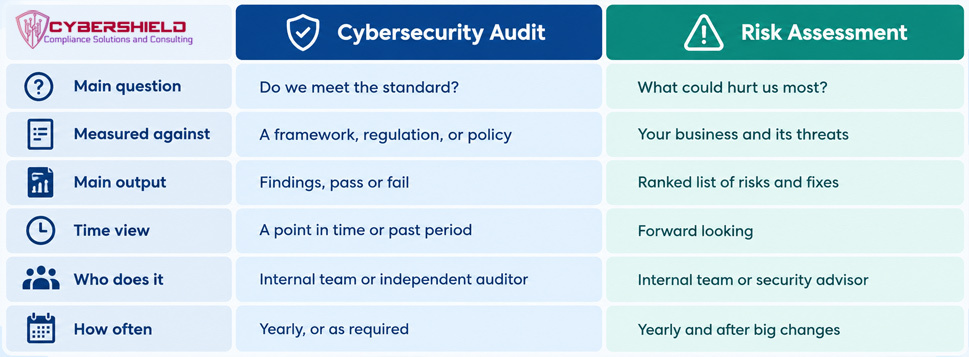
Why You Usually Need Both
In our experience, the businesses that struggle most with audits are the ones that skipped the risk assessment. They try to meet every requirement at once, burn through budget on low priority items, and still get caught on basics like old user accounts or untested backups.
Flip it around and the path gets much easier. A risk assessment tells you where you’re exposed. You fix the biggest problems first. Then the audit confirms those fixes hold up and gives you something official to hand your customers.
A risk assessment without an audit leaves you with a good plan and no proof. An audit without a risk assessment gives you proof of compliance, maybe, without much confidence that you’re protected from the attacks most likely to hit you.
So Which One Should You Start With?
If someone has asked you for formal evidence, like a SOC 2 report or a compliance certificate, you’re heading toward an audit. Still, we’d strongly suggest a risk assessment and readiness review first. Walking into an audit blind is how companies end up with a stack of findings and a delayed report.
If nobody’s asking yet, start with the risk assessment. It’s the best way to figure out which compliance standards are must haves for your industry and which ones you can safely ignore for now.
And if your business has changed recently, maybe you opened a second office, moved to the cloud, or went mostly remote, your old assessment is probably out of date. Run a new one.
How CyberShield CSC Helps
We do both kinds of work every week, mostly for small and midsize companies in healthcare, finance, legal, and tech. Our team has hands on experience with NIST, ISO 27001, SOC 2, HIPAA, and PCI DSS, so we can usually tell within a first call what a customer or regulator is really asking for.
Through our vCISO services, we run your risk assessment from start to finish. We’ll interview your team, map your critical systems, score the risks, and give you a roadmap written for business owners rather than engineers. Our cyber compliance team then helps close the gaps, gather evidence, and get you ready for the auditor.
Over time, we help you move toward stronger foundations like zero trust security for SMBs, so each review builds on the last one. If you’ve never worked with an outside security partner before, it helps to know what to expect when outsourcing cybersecurity. We’re glad to walk you through that on a quick call.