
SOC vs SIEM vs XDR vs MDR: What’s the Difference?
Ask five people in to explain SOC, SIEM, XDR, and MDR, and you will probably get five different answers. That’s not because the terms are hard to understand. Vendors have spent years stretching these acronyms to fit whatever they happen to be selling, and business owners are left confused about what they actually need.
These four terms are not competing options where you pick one and ignore the rest. They describe different pieces of a security puzzle, and understanding how they fit together will help you make smarter decisions about your cybersecurity budget.
What Is a SOC?
A Security Operations Center, or SOC, is a team of people. Think of it as mission control for your organization’s cyber defense. Analysts sitting in a SOC watch for suspicious activity around the clock, investigate alerts, and respond when something looks wrong.
A SOC can be built in house, which is expensive and hard to staff given the ongoing shortage of skilled analysts. Or it can be outsourced, which is why many growing businesses now rely on managed security partners instead of hiring an entire internal team. A SOC isn’t software. It’s the human layer that makes sense of everything the technology reports. If you want a deeper look at how modern SOC teams operate, our earlier post on AI based Security Operations Centers walks through it in detail.
What Is SIEM?
SIEM stands for Security Information and Event Management. This is the software platform that collects log data from across your network, servers, applications, and endpoints, then correlates that data to flag anomalies.
Picture SIEM as a giant filing cabinet with a very sharp assistant. It pulls records from across your IT environment and looks for patterns that could suggest something is amiss, such as a login from a weird location at 3am. The catch is that SIEM tools generate a huge volume of alerts, and someone still has to review them. Without skilled analysts interpreting what SIEM surfaces, you end up drowning in notifications instead of catching real threats. That’s part of why relying on a single tool rarely works, a point we unpacked further in why antivirus alone is no longer enough.
What Is XDR?
Extended Detection and Response, or XDR, takes things a step further. Rather than just collecting logs like SIEM does, XDR actively connects data across endpoints, email, cloud workloads, and network traffic into a single, unified view. It correlates related signals across your environment so you see the full story of an attack, not just isolated fragments.
If SIEM is the filing cabinet, XDR is more like a detective who already cross referenced every file in the building. Many organizations are pairing XDR with a zero trust security model, as both are predicated on the principle of verify everything, assume nothing and catch threats before they spread.
What Is MDR?
Managed Detection and Response, or MDR, is a service, not a tool. It combines technology, often SIEM or XDR platforms, with a team of security experts who monitor your environment, investigate alerts, and respond to threats on your behalf.
This is the piece that ties everything together for small and mid sized businesses. Most companies don’t have the budget for an internal SOC team working three shifts a day. MDR gives you that same round the clock coverage as a service. It’s the practical answer to a real problem: threats don’t take weekends off, but most in house IT teams do.
So How Do These Actually Compare?
Here’s a simple way to think about it. SIEM and XDR are the technology. SOC is the human team. MDR is the packaged service that often includes both. You could have a SIEM platform sitting unused because no one has time to review its alerts. You could have a SOC with no advanced tooling, relying on manual processes. MDR exists because most businesses need the technology and the people, but can’t build both from scratch.
None of these tools replace good governance either. A dashboard full of alerts means nothing if there’s no strategy behind how your organization handles risk, meets compliance obligations, and prioritizes what gets fixed first. Detection and compliance need to move together, not sit in separate silos.
The Role of CyberShield CSC
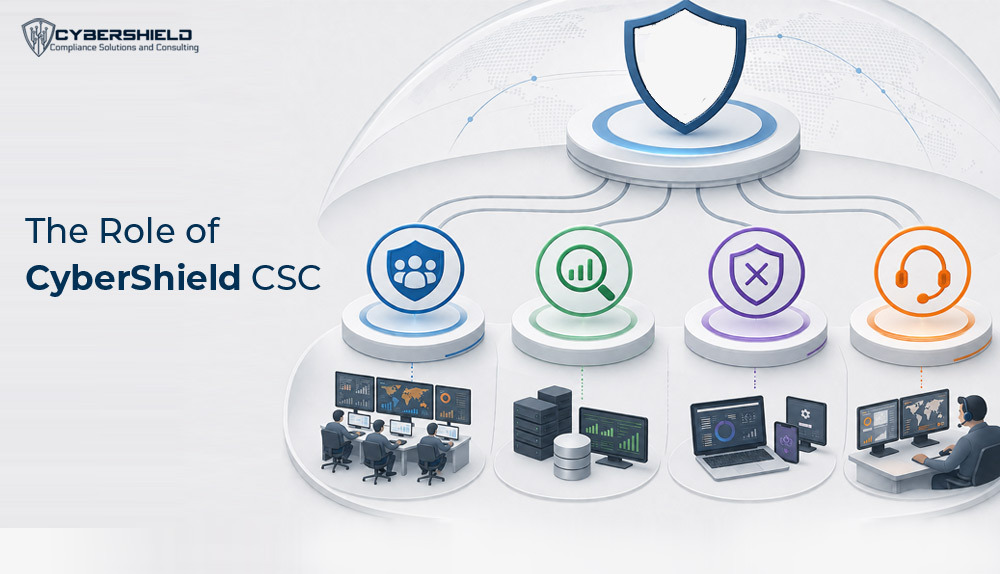
This is exactly where CyberShield CSC fits in. We don’t hand you a tool and walk away. Our role is to sit above all four of these layers, SOC, SIEM, XDR, and MDR, and make sure they’re actually working toward your business goals rather than just generating noise.
Through our vCISO service, we act as your fractional security leader. That means we interpret what your SOC or MDR provider is reporting, decide which alerts actually matter, and set the security roadmap so you’re not paying for technology that nobody understands. A vCISO also handles the parts that pure detection tools can’t touch: policy development, vendor risk, incident response planning, and board level reporting.
We pair that leadership with hands on compliance support. Detection tools generate data, but regulators want proof of process. Our cyber compliance services help you align your SOC, SIEM, or MDR setup with frameworks like ISO 27001, HIPAA, GDPR, and SOC 2, so the same monitoring that catches threats also keeps you audit ready.
Put simply, our job is to translate acronyms into outcomes. You get a dedicated point of contact who understands your industry, reviews what your tools are telling you, and adjusts your defenses as new risks show up. That’s a very different experience than juggling five vendor dashboards on your own.
If you’re trying to figure out whether your business needs a SOC, a SIEM upgrade, XDR, MDR, or some combination of all four, reach out to our team for a straightforward assessment. We’ll tell you what you actually need, not what’s easiest for us to sell.