


Cybersecurity for Law Firms: Compliance and Risk Management
Law firms sit on some of the most sensitive data that exists. Merger negotiations, litigation strategies, personal injury details, criminal defense files — all of it flows through email servers, case management platforms, and cloud storage every single day. And yet, cybersecurity is still treated as an afterthought at many practices.
That’s a problem, because threat actors know exactly where the valuable data lives. Law firms are consistently ranked among the top-targeted industries in annual breach reports, and the consequences go far beyond a fine. A single breach can cost a firm its reputation, its client relationships, and in some cases, its bar standing.
Why Law Firms Are a High-Value Target
Think about what a law firm holds: privileged communications, financial records, real estate transactions, intellectual property, healthcare data in litigation cases. That’s a goldmine for ransomware groups who know attorneys will pay to recover client files. It’s equally attractive to foreign intelligence agencies looking for competitive intelligence tied to corporate M&A deals.
The American Bar Association’s 2023 Legal Technology Survey reported that 29% of law firms had experienced a data breach at some point. For small firms with fewer than ten attorneys, the number was even more unsettling because the recovery resources simply aren’t there.
And here’s what makes the legal sector particularly tricky: attorney-client privilege doesn’t disappear when data moves to the cloud. Firms are ethically obligated to protect it regardless of where it lives or how it’s transmitted.
The Compliance Landscape for Legal Practices
Law firms don’t operate under a single federal cybersecurity regulation the way healthcare organizations deal with HIPAA. The compliance picture is patchier, and that actually makes it harder to navigate.
Depending on your firm’s practice areas and client base, you may be subject to several overlapping requirements:
State Bar Ethics Rules — Most state bars have issued formal guidance tying competency requirements under Model Rule 1.1 to technology awareness. Failing to implement reasonable data security measures can constitute an ethics violation.
State Data Privacy Laws — California’s CPRA, New York’s SHIELD Act, and a growing number of similar statutes apply to law firms that handle personal information of state residents. These laws carry notification requirements and can trigger civil penalties.
FTC Safeguards Rule — Law firms that handle financial data in connection with transactions may fall under FTC oversight, particularly if they qualify as financial institutions under the Gramm-Leach-Bliley Act.
HIPAA — Firms representing healthcare clients or handling protected health information as a business associate face HIPAA obligations, including Security Rule requirements and breach notification timelines.
SEC and FINRA Requirements — Securities law firms and those advising regulated financial entities need to align with SEC’s cybersecurity disclosure rules, which got significantly stricter in 2023.
Working through which of these apply to your practice is not a weekend project. It’s exactly the kind of ongoing guidance that a virtual CISO service is built to provide — without the six-figure salary of a full-time hire.
It’s also worth understanding how technology is reshaping compliance itself. AI-powered tools are now being used to monitor regulatory posture in real time, flag anomalies, and generate audit-ready reports automatically. If you want to understand how that works in practice, this breakdown of the role of AI in continuous cyber compliance and risk assessment is a good starting point.
The Biggest Cyber Risks Facing Law Firms Right Now
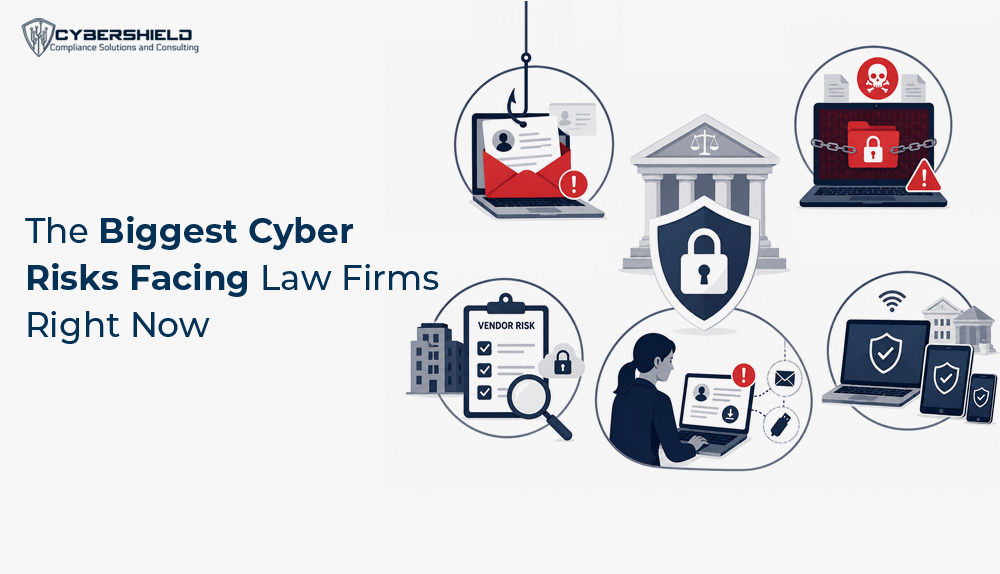
Phishing and Business Email Compromise (BEC) — Attorneys receive hundreds of emails daily. A spoofed wire transfer request or a fake client email that drops malware is hard to catch when you’re moving fast. BEC attacks cost legal sector firms millions annually, and they often exploit the trust embedded in attorney-client communications.
Ransomware — Law firms are lucrative ransomware targets because downtime is catastrophic. Billing stops, court deadlines can’t be met, client communications go dark. Attackers know this and price their demands accordingly.
Third-Party Vendor Risk — Your firm’s security is only as strong as the weakest vendor in your ecosystem. Case management software, e-discovery platforms, cloud storage providers, even the IT company you outsource to — all of them are potential entry points. A rigorous cyber compliance program includes vendor risk assessments, not just internal controls.
Insider Threats — Not always malicious. A paralegal emailing files to a personal account for remote access, a departing partner downloading client lists, or a staff member reusing passwords across personal and professional accounts — these are the quiet risks that don’t make headlines but drive a significant share of breaches.
Inadequate Endpoint Security — Attorneys work from courthouses, hotels, home offices, and client sites. Each of those connections is a potential exposure point if endpoint protection isn’t enforced consistently.
Building a Risk Management Framework That Actually Works
The firms that handle cybersecurity well don’t treat it as a once-a-year compliance exercise. They build it into how the practice operates.
Start with a formal risk assessment. Map where data lives, who can access it, how it moves, and what happens if it’s compromised. You can’t protect what you haven’t inventoried. If you’re building this from scratch, it helps to understand how modern practices approach the full journey — from initial assessment through to operational resilience. This guide on building a modern cyber defense strategy walks through that progression in detail.
From there, the framework should address four areas:
Access Control : Least privilege access means attorneys and staff can only reach the data they need for their specific role. Multi-factor authentication (MFA) should be non-negotiable, especially for remote access and email.
Incident Response Planning — Most firms don’t have a written incident response plan until after they’ve had a breach. That’s backwards. Know in advance who gets notified, what the containment steps are, and how client communication gets handled. Regulatory notification timelines under state breach laws are tight — often 30 to 72 hours.
Employee Training — The technical controls matter, but your people are still the primary attack surface. Phishing simulations, secure email practices, and clear protocols for wire transfer verification are worth more than most software purchases.
Ongoing Monitoring — Threats don’t take weekends off. Continuous monitoring for unusual access patterns, failed login attempts, and data movement alerts you to problems before they become breaches. This is where outsourcing cyber compliance to a dedicated provider pays for itself quickly — because the monitoring happens around the clock without adding headcount.
What a Breach Actually Costs a Law Firm
The financial math is fairly direct. The 2024 IBM Cost of a Data Breach Report put the average breach cost across industries at $4.88 million. Legal sector breaches tend to run higher because of the notification complexity, litigation exposure, and reputational fallout.
Beyond the dollar figure: bar grievances can be filed against attorneys whose negligence contributed to a breach. Malpractice claims follow. Clients leave. The firm’s ability to attract lateral talent drops. For smaller practices, some of these events are simply not survivable.
The cost of prevention — a proper security program, compliance monitoring, and expert guidance — is a fraction of the cost of response.
The bottom line:
cybersecurity isn’t a technology problem that lives with your IT vendor. For law firms, it’s a professional responsibility issue, a business continuity issue, and an ethical obligation. Getting it right requires treating it like the strategic priority it is — not a checkbox that gets revisited once a year.
If you’re ready to build a security program that fits your firm’s size, budget, and practice areas, contact CyberShield CSC to get started.