
The Role of AI in Continuous Cyber Compliance and Risk Assessment
If your auditor walked into your office tomorrow morning, would you pass? Most companies answer that question with a confident yes, then quietly spend the next two weeks rebuilding evidence before the actual audit starts.
That gap between what your compliance program claims and what’s actually happening in your environment is where breaches, fines, and lost deals live. The old model (annual audits, quarterly attestations, manual control testing) was designed for a world where IT changed slowly. That world is gone. Cloud workloads spin up in seconds. Vendors are onboarded by the dozen. Configurations drift hourly. Static compliance can’t keep up.
This is where AI in cyber compliance moves from buzzword to genuine capability. Used well, AI doesn’t replace your compliance team. It gives them the one thing they’ve never had: a real-time view of what’s compliant, what’s drifting, and what’s actually exposed. Used badly, it becomes another dashboard nobody reads.
Here’s how the shift to AI-driven continuous compliance actually works, what it does for your risk posture, and what to look for when evaluating Cyber Compliance Services that claim to deliver it.
Understanding Continuous Cyber Compliance in Modern Businesses
Continuous cyber compliance is exactly what it sounds like: a posture where your controls, evidence, and risk picture are validated continuously rather than at scheduled checkpoints.
In practical terms, that means every control (access reviews, encryption settings, patching cadence, log retention, third-party assessments) is monitored automatically, evidence is collected in the background, and deviations trigger alerts the same hour they happen, not the next quarter. Auditors don’t need to be handed a curated binder. They query the system and see live data.
This shift matters because regulatory expectations have already moved. HIPAA, PCI DSS 4.0, NIST CSF 2.0, ISO 27001:2022, and the upcoming SEC cybersecurity disclosure rules all assume continuous monitoring as a baseline. “We assess controls annually” is no longer a satisfying answer.
Why Traditional Compliance Models Are No Longer Effective
The traditional model has three structural problems that no amount of effort can fix.
It’s a snapshot, not a movie. Point-in-time audits validate that controls existed on a specific Tuesday in March. They say nothing about whether those controls held the other 364 days of the year.
It’s manual, so it’s expensive and slow. Spreadsheet evidence collection, screenshot binders, and email-based control attestations don’t scale beyond a few dozen controls. Most enterprises have hundreds.
It’s disconnected from real risk. A clean SOC 2 doesn’t mean you’re not breached. Equifax was compliant. Target was compliant. Compliance frameworks were never designed to detect active attacks.
None of these are solved by hiring more compliance analysts. They require a different operating model.
The Role of AI in Continuous Compliance Monitoring
AI in compliance does five concrete jobs today. Anything beyond these is marketing.
- Ingest telemetry from across the environment (cloud configs, IAM logs, endpoint signals, vulnerability scans, ticket systems, HR feeds) into a unified picture.
- Map that telemetry to control frameworks automatically (the same evidence point can satisfy SOC 2, HIPAA, ISO 27001, NIST CSF, and PCI DSS controls simultaneously).
- Detect drift and exceptions in real time, flagging when a control has degraded or a new asset has appeared outside policy.
- Correlate control gaps with active threat intelligence to prioritize what actually needs fixing first.
- Generate evidence and narrative documentation in a form auditors will accept, automatically.
That’s automated compliance monitoring at the operational level. The AI isn’t magic. It’s pattern recognition, classification, and language generation applied to a problem that drowns humans in volume.
How AI Enhances Cyber Risk Identification and Scoring
AI risk assessment cybersecurity capabilities shine in three places where traditional scoring fails.
The first is context. Traditional CVSS scoring tells you a vulnerability is severity 9.8 critical. AI-driven risk scoring adds the missing layer: is this vulnerability on an internet-facing system, does it touch sensitive data, is there an active exploit in the wild, has it been patched on similar systems already? The output is a contextual risk score that reflects what would actually happen to your business, not a number copied from NIST’s database.
The second is volume. A modern mid-sized environment generates hundreds of thousands of risk signals weekly. AI clusters and deduplicates these into manageable issues. Instead of 47,000 alerts, you get the 12 themes that matter.
The third is prediction. Machine learning models trained on historical incident data can flag combinations of conditions that have led to breaches elsewhere (an unpatched vulnerability, a misconfigured S3 bucket, a recently granted privileged role) before they line up in your environment too.
AI-Powered Vulnerability Management and Threat Detection
Vulnerability management without AI is a triage nightmare. Scanners produce thousands of findings, most teams can patch a few dozen per week, and the gap between “discovered” and “closed” stretches into months.
AI changes the economics. It correlates vulnerabilities with exploit availability (CISA KEV, exploit-DB, dark web chatter), business criticality of the affected asset, the presence of compensating controls, and the historical patching success rate for similar systems. The result is a ranked work queue where the top item is genuinely the highest-impact next move, not just the loudest scanner finding.
On the detection side, behavioral AI in EDR and XDR platforms catches what signature-based tools miss: living-off-the-land techniques, credential abuse, insider misuse, and supply-chain attacks. Modern threat detection is unrecognizable from where it stood five years ago, and AI is the reason.
Continuous Risk Assessment Using Machine Learning Models
AI-driven risk management treats risk as a continuously updated number, not a quarterly report.
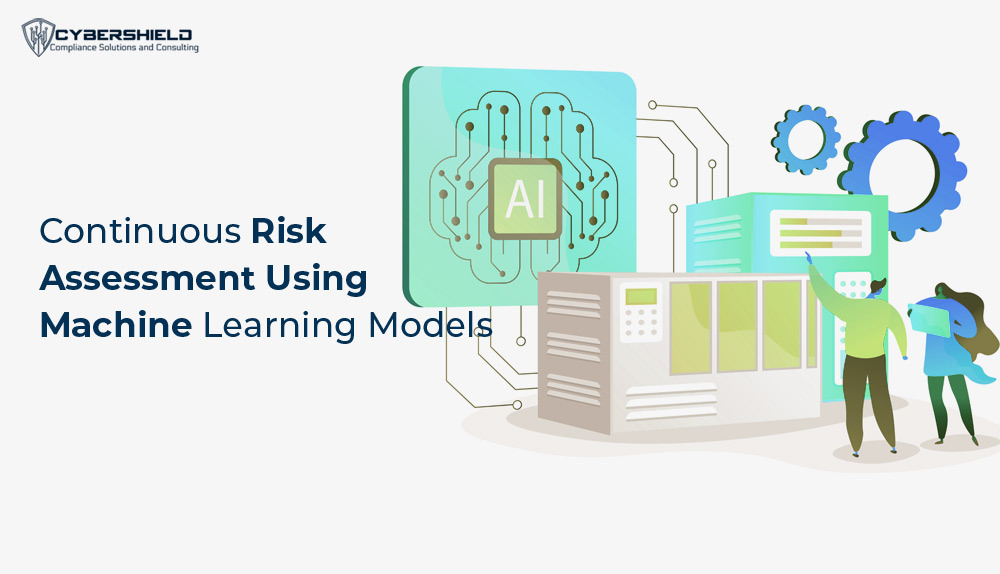
Machine learning models ingest current control state, current threat landscape, current asset inventory, current vendor posture, and current incident history. They output a residual risk score per asset, per business unit, per control domain. When a new vendor is added, the model recalculates. When a control degrades, the model recalculates. When a new exploit hits the wild for software you run, the model recalculates.
That continuous recalculation does something a quarterly assessment never can: it tells you the day your risk profile changed, not the quarter you happened to notice.
Real-Time Compliance Reporting with AI Automation
Auditors and regulators are starting to ask for evidence that controls operated continuously, not just that they were designed correctly. AI-driven reporting answers that question directly.
A modern compliance platform generates dashboards by framework (SOC 2, HIPAA, PCI DSS, ISO 27001, NIST CSF, CMMC), shows control status with live data, surfaces exceptions with timestamps and remediation history, and produces audit-ready evidence packages on demand. The narrative explanations (“why did this control fail for 11 minutes on March 4?”) are increasingly being drafted by large language models trained on the underlying telemetry.
The hours saved are real. Compliance teams we work with consistently report 60-80% reductions in evidence preparation time after moving to AI-assisted continuous monitoring. That time gets reinvested in actually improving controls instead of documenting them.
Reducing Human Error Through AI-Driven Compliance Tools
Manual compliance work is error-prone for boring reasons. Analysts copy-paste evidence into the wrong control. They mark a control compliant based on a stale screenshot. They miss a deprovisioning event because HR didn’t send the email.
AI-driven tools remove most of these failure modes. Evidence is pulled directly from systems of record, not retyped. Control status reflects current configuration, not last quarter’s screenshot. Deprovisioning happens through identity automation tied to HRIS triggers, not email.
This isn’t about replacing compliance professionals. It’s about removing the busywork that makes them ineffective at the strategic work only they can do (risk decisions, control design, policy work, executive communication).
Integrating AI Compliance with Existing Security Frameworks
The right way to introduce AI compliance is on top of, not instead of, your existing framework.
If you’re built on NIST CSF, the AI layer maps controls to the Identify, Protect, Detect, Respond, Recover functions. If you’re SOC 2 audited, it maps to Trust Service Criteria. If you’re HIPAA-regulated, it maps to the Security Rule administrative, physical, and technical safeguards. A single evidence point (MFA enabled on all production accounts, for example) satisfies dozens of overlapping control requirements at once. The integration work is in the mapping, not in the underlying data collection.
Done well, this means one continuous compliance program rather than five parallel ones. The cost reduction is substantial, but the strategic benefit is bigger: you stop arguing about which framework owns which control and start operating a unified posture.
Business Benefits of AI-Based Continuous Cyber Compliance
The compliance benefits are obvious. The business benefits are where the real ROI sits:
- Faster sales cycles. Security questionnaires that used to take two weeks get returned in a day, because evidence is live and ready.
- Lower audit costs. Auditors spend less time gathering evidence and more time validating findings. Many firms now offer reduced fees for clients on continuous monitoring platforms.
- Reduced breach impact. Continuous detection of control drift closes the gaps attackers exploit between audits.
- Better board reporting. Risk posture becomes a number that moves over time, not a binder presented quarterly.
- Real cyber insurance leverage. Insurers increasingly offer better terms to companies that can demonstrate continuous compliance. Some won’t write coverage without it.
The break-even on AI-driven compliance investment is typically inside 12 months for mid-market organizations. For enterprise, it’s faster.
How Cybershield CSC Helps
Cybershield CSC delivers Cyber Compliance Services that combine AI-driven monitoring platforms with the human expertise that makes them actually work. We help businesses move from annual audit panic to continuous, framework-aligned compliance across SOC 2, HIPAA, PCI DSS, ISO 27001, NIST CSF, and CMMC.
Whether you’re starting your first SOC 2, modernizing a stale compliance program, or trying to unify five different framework efforts into one, we can shorten the timeline and reduce the lift. Reach out for a 30-minute compliance readiness review. We’ll walk through where your program stands today, where the highest-leverage AI investments are, and what a 90-day continuous compliance plan looks like. No pitch, no obligation.